-


- Industries
-
Ordering
Food Grocery Home Services -
Delivery & Dispatch
Pick Up & Delivery Courier Delivery 3PL Delivery Dispatch -
Consultation
Telemedicine Fitness Legal Consultation -
Mobility
Taxi Software App Like Uber Car Rental -
Customer Engagement
Conversational support WhatsApp Marketing Customer Acquisition -
Sales Engagement
Inbound Sales Pipeline Management Sales Performance Analytics
Explore All Industries
-
-
Learn
- Partner
- Pricing







Blog Yelo
Yelo
How to Create Online Ordering for a Restaurant (That Gets Results)
In the modern food service landscape, online ordering for restaurants has become a powerful growth engine rather than a supporting feature. Customers now expect speed, convenience, and digital-first experiences when ordering food. Because of this shift, restaurants that adopt online ordering for restaurants early often outperform competitors in revenue, customer retention, and operational efficiency. More importantly, online ordering for restaurants is no longer limited to large chains—it is now essential for cafés, cloud kitchens, and independent eateries alike.
This in-depth guide explains how to build online ordering for restaurants that actually delivers results, supported by industry statistics, proven strategies, and practical implementation steps.
Why Online Ordering for Restaurants Is No Longer Optional
To begin with, customer behavior has permanently changed. Digital convenience now defines how people choose where—and how—to eat.
According to industry data, over 60% of restaurant orders are placed digitally, either through websites or mobile apps. At the same time, mobile devices account for more than 70% of online food orders, making mobile-first experiences critical. Additionally, research shows that customers spend 15–30% more per order online compared to dine-in or phone orders due to add-ons and upselling opportunities.
As a result, restaurants without online ordering are quietly losing revenue every single day.
Changing Consumer Expectations
Today’s customers expect more than just food delivery. Instead, they want:
- Easy browsing and customization
- Multiple digital payment options
- Order tracking and live updates
- Personalized offers and loyalty rewards
In fact, 67% of customers prefer ordering directly from a restaurant’s own website or app rather than third-party platforms. This preference exists because customers trust direct brands more and want transparent pricing.
Consequently, online ordering for restaurants has become a critical touchpoint in the customer journey.
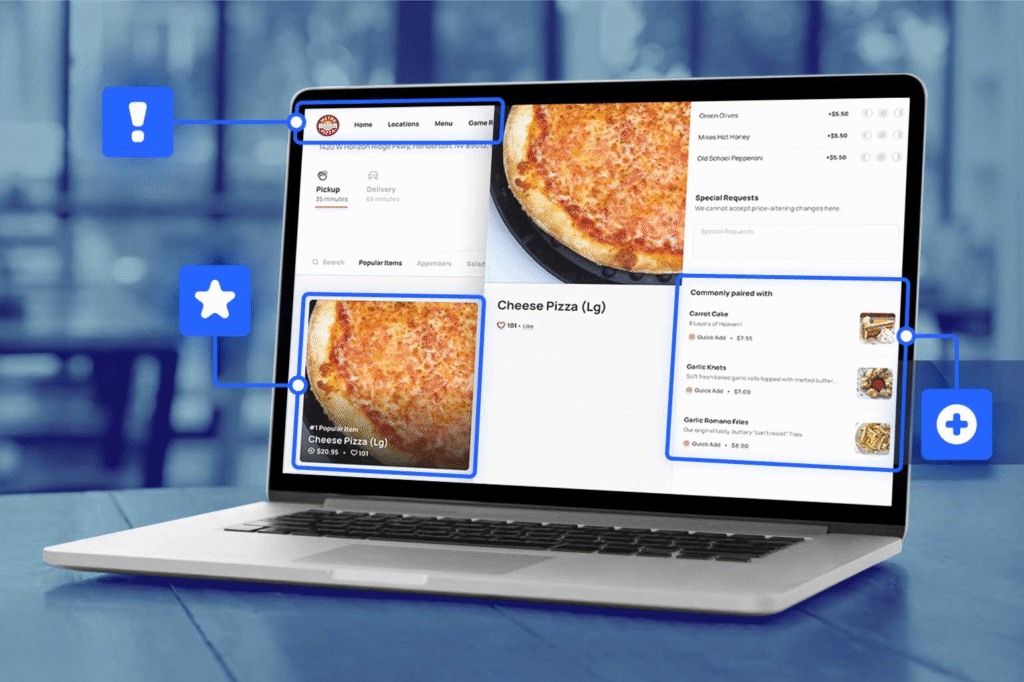
Revenue Impact of Online Ordering
From a financial perspective, the impact is significant. Studies show that digital and phone orders together contribute nearly 67% of total restaurant revenue. In fast-casual and quick-service restaurants, that number can rise to 75% or more.
Moreover, the global online food ordering market is projected to grow from $243 billion in 2025 to over $785 billion by 2035, driven by urbanization, mobile penetration, and lifestyle changes.
Clearly, the growth opportunity is massive.
What Is Online Ordering for Restaurants?
At its core, online ordering for restaurants allows customers to place food orders digitally through a website or mobile app. These orders can be fulfilled via delivery, pickup, curbside, or dine-in.
However, modern online ordering goes far beyond basic order placement. It includes:
- Digital menus
- Payment processing
- Order management
- Customer data collection
- Marketing automation
- Loyalty and rewards
Therefore, online ordering functions as a complete digital sales channel rather than a simple ordering tool.
Key Benefits of Online Ordering for Restaurants
When implemented correctly, online ordering for restaurants delivers measurable benefits across revenue, operations, and customer experience.
1. Higher Average Order Value
First and foremost, online menus encourage exploration. Customers can browse without pressure, compare items, and add extras easily.
As a result:
- Average order value increases by 15–30%
- Add-ons and combos perform significantly better
- Visual menus drive impulse purchases
This single factor alone can dramatically increase monthly revenue.
2. Increased Order Frequency
Digital customers tend to reorder more often. Saved addresses, payment methods, and past orders reduce friction.
In fact, customers who use online ordering place orders up to 67% more frequently than offline customers. Over time, this directly increases customer lifetime value.
3. Lower Operational Errors
Phone orders are prone to miscommunication. Online ordering eliminates this issue by letting customers input their own preferences.
Consequently:
- Order accuracy improves
- Kitchen errors reduce
- Refunds and complaints decrease
This leads to smoother operations during peak hours.
4. Ownership of Customer Data
Third-party platforms limit access to customer information. In contrast, online ordering for restaurants enables full ownership of customer data.
With this data, restaurants can:
- Send targeted promotions
- Launch loyalty campaigns
- Analyze buying patterns
- Improve menu decisions
Data ownership becomes a long-term competitive advantage.
5. Reduced Dependency on Aggregators
Third-party delivery platforms typically charge 20–30% commission per order. Over time, this significantly impacts profit margins.
By shifting repeat customers to direct online ordering, restaurants can:
- Retain more profit
- Control pricing
- Build direct relationships
This strategy alone can save lakhs annually for growing restaurants.
Essential Features of High-Performing Online Ordering for Restaurants
To achieve consistent results, online ordering for restaurants must include the right features.
Mobile-First User Experience
Since most orders come from smartphones, mobile optimization is non-negotiable.
A successful interface should:
- Load quickly
- Use large, readable buttons
- Minimize checkout steps
- Offer one-tap reordering
A poor mobile experience often leads to abandoned carts.
Optimized Digital Menu Design
Menu design directly influences conversion rates.
Best practices include:
- Clear categories
- Short descriptions
- High-quality images
- Highlighted bestsellers
Studies show that menus with images can increase sales by up to 25%.
Multiple Payment Options
Payment flexibility increases conversions.
A strong system supports:
- Credit and debit cards
- UPI and wallets
- Contactless payments
- Saved payment methods
In India alone, restaurant UPI transactions have grown by over 30% year-on-year, proving how critical digital payments have become.
Order Tracking and Notifications
Customers want transparency.
Real-time updates such as:
- Order confirmed
- Preparing
- Out for delivery
help reduce anxiety and customer support queries while improving satisfaction.
Loyalty and Rewards Programs
Loyalty drives retention.
Restaurants with digital loyalty programs experience:
- 30–40% higher repeat order rates
- Stronger brand recall
- Increased average order frequency
Even simple reward systems can make a noticeable difference.
Step-by-Step Guide to Implement Online Ordering for Restaurants
Step 1: Define Clear Business Goals
Before launching, identify what success looks like.
Common goals include:
- Increasing revenue
- Reducing commissions
- Improving repeat orders
- Capturing customer data
Clear objectives guide technology and marketing decisions.
Step 2: Choose the Right Technology Approach
Restaurants typically choose between three options:
Custom Development
Offers full control but requires higher investment and maintenance.
Ready-Made Platforms
Enable faster launch, scalability, and lower costs.
Hybrid Approach
Uses aggregators for discovery while pushing loyal customers to direct ordering.
For most restaurants, platform-based solutions provide the best balance.
Step 3: Design the Customer Ordering Journey
Next, map every step of the customer journey.
This includes:
- Landing page
- Menu browsing
- Item customization
- Cart review
- Payment
- Confirmation
- Tracking
Reducing friction at each stage improves conversions significantly.
Step 4: Integrate Kitchen and Operations
Orders should flow directly to the kitchen display or POS system.
This ensures:
- Faster preparation
- Reduced manual work
- Better order sequencing
Operational integration is critical for scaling order volume.
Step 5: Test Before Launch
Testing prevents costly mistakes.
Check:
- Payment success rates
- Menu accuracy
- Notification timing
- Mobile responsiveness
A smooth first experience increases retention.
Step 6: Promote the Platform
Once live, promote aggressively.
Effective channels include:
- Social media
- SMS and WhatsApp
- Email marketing
- In-store QR codes
Offering first-order discounts accelerates adoption.
How Online Ordering for Restaurants Drives Long-Term Growth
When optimized continuously, online ordering for restaurants becomes a long-term growth asset.
Restaurants typically see:
- 20–40% of total revenue from online channels
- Lower customer acquisition costs
- Stronger brand loyalty
- Predictable order volume
Over time, data-driven improvements further amplify these results.
Common Mistakes Restaurants Must Avoid
Despite the benefits, mistakes can limit success.
Avoid:
- Long checkout processes
- Slow-loading menus
- No mobile optimization
- Lack of incentives for direct orders
- Ignoring analytics
Fixing these issues improves performance quickly.
Future Trends in Online Ordering for Restaurants
Looking ahead, several trends are shaping the future.
AI-Driven Personalization
Smart recommendations already increase order value by up to 30%.
QR-Based Ordering
Contactless ordering continues to grow, especially in dine-in settings.
Predictive Reordering
Platforms are beginning to suggest repeat orders automatically.
Restaurants that adapt early gain a strong competitive edge.
How Yelo Powers Online Ordering for Restaurants
Building scalable online ordering for restaurants can be complex without the right technology. This is where Yelo plays a crucial role.
Yelo enables restaurants to launch fully branded online ordering websites and mobile apps with minimal effort. From menu management and payments to loyalty programs and analytics, everything is managed through a single dashboard.
Most importantly, Yelo helps restaurants:
- Reduce dependency on aggregators
- Retain customer data
- Increase repeat orders
- Improve profit margins
By combining technology, marketing tools, and operational efficiency, Yelo empowers restaurants to succeed in a digital-first world.
Final Takeaway
To conclude, online ordering for restaurants is no longer an optional upgrade—it is a core business strategy. Restaurants that invest in seamless digital ordering today position themselves for sustained growth, higher profitability, and stronger customer relationships tomorrow.
Subscribe to stay ahead with the latest updates and entrepreneurial insights!
Share this article:


Subscribe to our newsletter
Get access to the latest industry & product insights.
You may be interested in these articles
-
Yelo28th January 2026
How AI Is Transforming Hyperlocal Marketplaces in 2026: From Personalisation to Autonomous DeliveryUrban commerce in 2026 is no longer defined by distance—it’s defined by.. [..]Read story
-
Yelo21st January 2026
Beyond the Storefront: How Direct-to-Consumer (D2C) Brands Are Reclaiming Their Margins in 20261. Introduction: The Great Decoupling of D2C Brands By 2026, the digital.. [..]Read story
-
Yelo14th January 2026
How Hyperlocal Delivery Is Changing Urban E-commerce: Trends and Predictions for 2026The retail landscape has undergone a dramatic transformation. As we move.. [..]Read story
-
Yelo7th January 2026
Mastering Hyperlocal Commerce: Proven Growth Strategies to Boost Orders for Local Businesses in 2026In the digital landscape of 2026, the way we perceive local commerce has.. [..]Read story