-


- Industries
-
Ordering
Food Grocery Home Services -
Delivery & Dispatch
Pick Up & Delivery Courier Delivery 3PL Delivery Dispatch -
Consultation
Telemedicine Fitness Legal Consultation -
Mobility
Taxi Software App Like Uber Car Rental -
Customer Engagement
Conversational support WhatsApp Marketing Customer Acquisition -
Sales Engagement
Inbound Sales Pipeline Management Sales Performance Analytics
Explore All Industries
-
-
Learn
- Partner
- Pricing








Blog Jungleworks
How Delivery Management Software Helps Businesses Grow
In today’s hyper-connected digital economy, the expectations placed on businesses have transformed dramatically. Customers no longer simply want their orders delivered—they demand real-time visibility, lightning-fast fulfillment, proactive communication, and seamless experiences from the moment they click “purchase” to the instant their package arrives at their doorstep. This shift in consumer behavior has fundamentally altered the competitive landscape across industries, making delivery excellence not just a value-add, but a critical business imperative.
Yet behind the polished customer-facing experiences that modern consumers have come to expect, many businesses face a harsh reality: operational chaos, coordination nightmares, delayed shipments, inefficient route planning, and mounting costs that threaten profitability. Manual processes that once sufficed in simpler times now buckle under the weight of growing order volumes, expanding delivery zones, and increasingly complex logistics networks.
This is precisely where delivery management software emerges as a transformative solution—a technological game changer that’s revolutionizing how businesses handle their last-mile delivery operations and enabling sustainable growth in an increasingly competitive marketplace.
The Last-Mile Delivery Challenge
Before exploring how delivery management software drives business growth, it’s essential to understand the magnitude of the challenges businesses face in their delivery operations. Last-mile delivery—the final leg of the journey from distribution center to customer—represents both the most expensive and most complex aspect of the entire logistics chain.
Studies consistently show that last-mile delivery accounts for up to 53% of total shipping costs, yet it’s also the stage where customer satisfaction is won or lost. A single delayed delivery, a missed time window, or poor communication can instantly erode brand trust that took years to build. Meanwhile, businesses juggling multiple delivery agents, dynamic route changes, traffic conditions, and varying customer availability windows often find themselves trapped in reactive firefighting mode rather than strategic planning.
Traditional delivery management approaches—spreadsheets, phone calls, manual dispatching, static routes—simply cannot scale effectively or deliver the agility modern businesses require. The complexity multiplies exponentially as order volumes grow, making manual coordination not just inefficient but practically impossible.
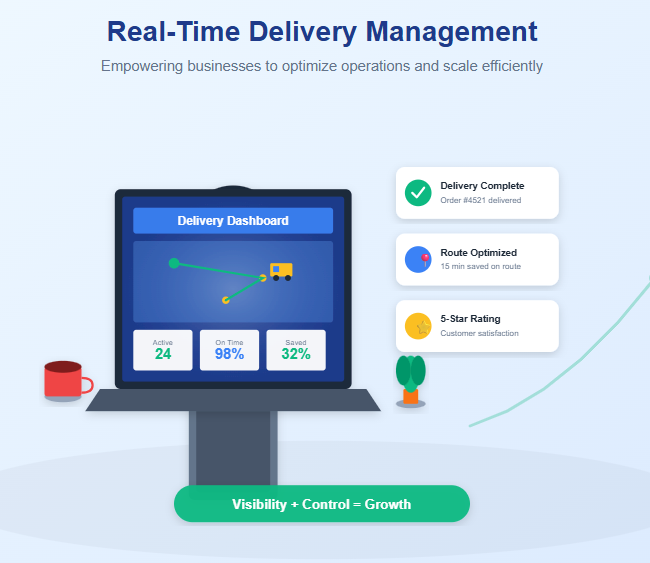
Enter Delivery Management Software: Your Growth Partner
Delivery management software like Tookan represents a fundamental reimagining of how businesses orchestrate their delivery operations. Rather than treating delivery as a chaotic, unpredictable process requiring constant manual intervention, these platforms transform it into a streamlined, intelligent, data-driven system that operates with precision and reliability.
At its core, delivery management software serves as the central nervous system for your entire delivery operation—connecting customers, dispatchers, delivery agents, and management teams in a unified ecosystem where information flows seamlessly, decisions happen intelligently, and execution occurs efficiently.
But the true value extends far beyond simple digitization. Modern delivery management platforms like Tookan leverage advanced technologies including artificial intelligence, machine learning, real-time GPS tracking, automated workflows, and predictive analytics to not just manage deliveries, but to continuously optimize them. This creates a compound effect where operations become progressively more efficient, costs decrease systematically, and customer satisfaction improves consistently over time.
Automated Dispatching: Intelligence at Scale
One of the most transformative features of delivery management software is automated dispatching—a capability that eliminates the bottleneck of manual order assignment and replaces it with intelligent, algorithm-driven allocation that happens in milliseconds.
Traditional dispatching requires a coordinator to manually review incoming orders, assess agent availability, consider geographical locations, evaluate workload distribution, and assign tasks one by one. This process is not only time-consuming and prone to human error, but it also fails to account for the dozens of variables that impact delivery efficiency—traffic patterns, agent skillsets, historical performance, priority levels, delivery time windows, and vehicle capacity constraints.
Tookan’s automated dispatching system processes all these variables simultaneously using sophisticated algorithms that optimize for multiple objectives: minimizing delivery time, balancing agent workloads, reducing fuel consumption, meeting customer time preferences, and maximizing the number of completed deliveries per shift. The system can instantly assign hundreds of orders across dozens of agents in the time it would take a human dispatcher to process a single assignment.
The business impact is profound. Companies implementing automated dispatching typically see 30-40% improvements in dispatcher productivity, allowing the same team to handle significantly higher order volumes without proportional increases in headcount. More importantly, the quality of assignments improves dramatically, with agents receiving routes that make logical sense, reduce backtracking, and enable them to complete more deliveries per day.
Smart Routing: The Shortest Path to Customer Satisfaction
While automated dispatching determines which agent handles which delivery, smart routing solves the equally critical question of in what sequence and along which path. This distinction might seem subtle, but its impact on operational efficiency and cost structure is enormous.
Smart routing technology goes far beyond simple GPS navigation. Tookan’s intelligent routing engine considers real-time traffic conditions, historical traffic patterns, road restrictions, delivery time windows, priority levels, and agent locations to dynamically calculate the optimal sequence and path for completing all assigned deliveries. As conditions change throughout the day, traffic accidents occur, deliveries take longer than expected, new urgent orders arrive—the system continuously recalculates and adjusts routes in real-time.
The efficiency gains from smart routing compound throughout the day. A route that saves just five minutes per delivery across ten deliveries per agent per day equals nearly an hour of additional productive time. Multiply that across a fleet of 20 agents working 250 days per year, and you’ve reclaimed 5,000 hours of productive capacity—equivalent to adding 2.5 full-time agents without any additional hiring.
Beyond time savings, smart routing dramatically reduces fuel consumption and vehicle wear-and-tear. Businesses typically report 20-25% reductions in fuel costs after implementing intelligent routing systems—savings that flow directly to the bottom line while simultaneously reducing environmental impact. For businesses operating delivery fleets, these cost reductions can represent the difference between profit and loss on delivery operations.
Real-Time Tracking: Visibility Transforms Operations
Information asymmetry—when some parties have information others lack—creates friction, anxiety, and inefficiency in any system. In traditional delivery operations, this asymmetry exists at multiple levels: customers don’t know where their delivery is, agents don’t have visibility into changing priorities, dispatchers can’t see real-time agent locations, and managers lack insight into operational performance until after the fact.
Real-time tracking capabilities in delivery management software eliminate this information asymmetry by creating complete visibility for all stakeholders. GPS-enabled mobile apps allow Tookan to track agent locations with precision, providing dispatchers with a live map view showing exactly where every agent is at any moment, what deliveries they’re completing, and how their actual progress compares to planned schedules.
This visibility transforms operational management from reactive to proactive. Instead of discovering problems after they’ve caused delays, dispatchers can spot potential issues as they develop—an agent running behind schedule, an unexpected cluster of failed deliveries, or a vehicle breakdown—and take corrective action immediately. They can reassign deliveries from overloaded agents to those with capacity, dispatch backup support to areas experiencing challenges, or proactively communicate delays to affected customers before they reach out to complain.
For customers, real-time tracking creates transparency that dramatically improves the delivery experience. Rather than sitting at home wondering when their package might arrive, they can watch their delivery approach on a live map, see accurate ETAs that update dynamically, and plan their day accordingly. This single feature has been shown to reduce “where is my order” support inquiries by up to 70%, freeing customer service teams to focus on higher-value interactions.
Live ETA Sharing: Managing Expectations Proactively
Closely related to real-time tracking but deserving its own attention is the capability to share live, dynamically updating estimated time of arrival (ETA) information with customers. While this might seem like a minor feature, its impact on customer satisfaction and operational efficiency is remarkably significant.
The psychology behind ETA sharing is well-established: uncertainty creates anxiety, while information—even information about delays created comfort. When customers receive accurate, updated ETAs, their satisfaction with the delivery experience improves dramatically, even when deliveries take longer than initially expected. They can see progress happening, understand that their order hasn’t been forgotten, and adjust their plans accordingly.
Tookan’s live ETA sharing leverages the same intelligent algorithms powering smart routing to calculate constantly updating arrival estimates that account for real-time conditions. As traffic patterns change, as previous deliveries take more or less time than expected, as routes get adjusted, customer-facing ETAs automatically update to reflect current reality. This dynamic updating is crucial—static ETAs that don’t adjust create their own problems when circumstances change.
From an operational perspective, accurate ETA sharing reduces the single biggest source of customer service burden in delivery operations: status inquiries. When customers have self-service access to accurate, updating information about their delivery, they don’t need to call, email, or chat with support representatives to get basic status updates. Businesses implementing live ETA sharing typically see 60-75% reductions in delivery-related customer inquiries, representing substantial cost savings in support operations.
Analytics and Business Intelligence: Data-Driven Decision Making
While operational features like dispatching, routing, and tracking deliver immediate daily value, the analytics capabilities built into modern delivery management software create strategic value that compounds over time. Every delivery, every route, every agent interaction generates data—and when that data is systematically captured, analyzed, and presented through intuitive dashboards, it becomes a powerful tool for continuous improvement.
Tookan’s analytics engine tracks dozens of key performance indicators across multiple dimensions: delivery completion rates, on-time performance, average delivery times, cost per delivery, agent productivity metrics, customer satisfaction scores, route efficiency, and much more. This data can be analyzed at various levels—individual agent performance, team comparisons, geographical patterns, time-based trends—providing managers with unprecedented insight into what’s working well and where opportunities for improvement exist.
The strategic value of this analytics capability cannot be overstated. Instead of making decisions based on gut feelings, anecdotes, or incomplete information, managers can rely on comprehensive data to guide resource allocation, identify training needs, optimize territorial assignments, evaluate the ROI of operational changes, and set realistic performance targets based on actual historical data.
Over time, this data-driven approach creates a culture of continuous improvement where small optimizations compound into significant competitive advantages. A 2% improvement in delivery completion rates might seem modest, but sustained over time across thousands of deliveries, it translates to hundreds of additional successful deliveries, higher customer retention, and improved profitability.
Scaling Operations Without Proportional Cost Increases
Perhaps the most compelling business case for delivery management software lies in its ability to enable operational scaling without proportional increases in overhead costs. This characteristic—the ability to handle substantially more volume with only marginal additional resources—is what transforms delivery from a cost center into a competitive advantage.
In traditional manually-managed delivery operations, growth creates linear or even exponential increases in complexity and cost. Doubling your delivery volume typically requires doubling your coordination staff, accepting significantly degraded efficiency, or both. The communication overhead, coordination complexity, and management burden grow faster than the actual delivery volume.
Delivery management software fundamentally changes this equation. Because the system handles coordination, optimization, tracking, and communication automatically, the marginal cost of processing additional deliveries is minimal. A business processing 100 deliveries per day can scale to 500 or 1,000 deliveries using the same platform, the same dispatching team, and only proportional increases in actual delivery agents and vehicles.
This scalability characteristic is what enables businesses using platforms like Tookan to pursue aggressive growth strategies without worrying that operational complexity will become a bottleneck. Whether you’re expanding into new territories, adding new product lines, acquiring new customer segments, or pursuing seasonal surges in demand, your delivery management infrastructure can scale seamlessly to support that growth.
Industry-Specific Applications and Benefits
While delivery management software provides universal benefits, its impact manifests differently across various industry verticals, each with unique operational challenges and customer expectations.
Food Delivery Services face extreme time sensitivity where every minute counts. Smart routing and real-time optimization ensure hot food arrives hot, while live tracking lets hungry customers know exactly when to expect their meals. Automated dispatching handles the chaos of overlapping orders during peak hours, and analytics help identify optimal staffing levels for different time periods.
Hyperlocal and Quick Commerce businesses promise delivery within 15-30 minutes, making operational efficiency absolutely critical. Delivery management software enables the rapid dispatching and ultra-optimized routing necessary to meet these aggressive timeframes consistently. Real-time visibility allows managers to identify and resolve bottlenecks instantly before they cascade into broader delays.
Logistics and Courier Companies manage diverse shipment types, varying priorities, and complex multi-stop routes. Features like proof of delivery capture, signature collection, and detailed tracking histories provide the documentation and accountability these operations require. Route optimization across large fleets generates substantial fuel savings that directly impact profitability.
Retail Brands expanding into same day or next day delivery compete directly with e-commerce giants. Delivery management software levels the playing field by providing enterprise-grade delivery capabilities without enterprise-level IT infrastructure investments. Branded tracking pages and communication maintain consistent customer experiences throughout the delivery journey.
Healthcare and Pharmaceutical Delivery requires specialized handling, compliance documentation, and absolute reliability. Temperature monitoring, chain of custody tracking, and priority routing for urgent medications become manageable through purpose-built delivery management workflows.
The Customer Experience Transformation
While operational efficiency and cost reduction are compelling business outcomes, perhaps the most significant impact of delivery management software manifests in transformed customer experiences that drive retention, referrals, and revenue growth.
Modern consumers judge businesses not just on product quality but on the entire end-to-end experience and delivery represents a crucial touchpoint where brand promises are either fulfilled or broken. A study by MetaPack found that 96% of consumers consider delivery important to their loyalty to a retailer, while 84% say they wouldn’t return after just one bad delivery experience.
Delivery management software transforms delivery from a potential source of friction into a competitive differentiator. Proactive communication keeps customers informed. Accurate ETAs respect their time. Real-time tracking provides transparency. Consistent on-time performance builds trust. Seamless experiences encourage repeat purchases and positive word-of-mouth.
These experience improvements translate directly into business metrics that matter: higher customer lifetime value, improved retention rates, increased order frequency, and reduced customer acquisition costs as satisfied customers become brand advocates who refer friends and family.
Implementation and ROI: The Path to Transformation
For businesses contemplating delivery management software adoption, questions naturally arise about implementation complexity, change management, and return on investment. The good news is that modern cloud-based platforms like Tookan are designed for rapid deployment with minimal disruption to ongoing operations.
Typical implementation timelines range from a few days to a few weeks depending on business complexity, number of integrations required, and extent of customization needed. The platform’s intuitive interfaces minimize training requirements for both dispatchers and delivery agents, while mobile apps work on standard smartphones without specialized hardware investments.
Return on investment typically manifests within the first few months through multiple channels: reduced fuel costs, improved agent productivity, decreased dispatcher overhead, lower customer support burden, and reduced losses from failed or delayed deliveries. Many businesses report that the software pays for itself within 60-90 days, with benefits continuing to compound thereafter.
Beyond quantifiable financial returns, businesses gain strategic capabilities that enable new business models and competitive positioning: the ability to offer same-day delivery profitably, to expand service territories without proportional cost increases, to provide premium delivery experiences that justify price premiums, and to make data-driven decisions that continuously improve operations.
Conclusion: Delivery as a Growth Engine
The evolution of delivery from operational necessity to strategic competitive advantage represents one of the most significant shifts in modern business. Companies that recognize this transformation and equip themselves with the technological tools to excel in delivery operations position themselves for sustainable growth in increasingly competitive markets.
Delivery management software like Tookan doesn’t just make existing processes more efficient—it fundamentally reimagines what’s possible in delivery operations. Automated dispatching, intelligent routing, real-time tracking, live ETA sharing, and comprehensive analytics work together to create a delivery operation that is faster, smarter, more reliable, and more cost effective than ever before.
For businesses operating in the delivery economy—whether you run a hyperlocal business, logistics company, food delivery service, retail brand, or any operation where getting products to customers quickly and reliably matters—delivery management software has evolved from nice-to-have to business-critical. The question is no longer whether to adopt these technologies, but how quickly you can implement them to capture competitive advantages before your rivals do.
The businesses that thrive in the coming decade will be those that deliver not just products, but exceptional experiences—from order to doorstep. Delivery management software provides the foundation for building that exceptional experience at scale, transforming delivery from cost center to growth engine, and from operational challenge to competitive differentiator.
Subscribe to stay ahead with the latest updates and entrepreneurial insights!
Share this article:


Subscribe to our newsletter
Get access to the latest industry & product insights.
You may be interested in these articles
-
Jungleworks9th February 2026
How Last-Mile Delivery Impacts Customer Experience & RetentionIn the age of instant gratification and on-demand services, last-mile delivery.. [..]Read story
-
Jungleworks4th February 2026
Delivery Management Software: A Complete Buyer’s Guide for 2026In today's fast-paced digital economy, efficient delivery operations can make.. [..]Read story
-
Jungleworks2nd February 2026
Delivery Software for Dark Stores & Quick Commerce: The Complete Guide for 2026The retail landscape has fundamentally transformed. With consumers demanding.. [..]Read story
-
Jungleworks27th January 2026
Last Mile Delivery KPIs Every Business Must TrackThe last mile of delivery - the final step in getting products from a.. [..]Read story