-


-
-
Softwares
Logistics

Tookan
Delivery management software for optimizing fleet operations

Evermile
Last-mile delivery orchestration platform with real-time tracking

Mappr
Route optimization and territory mapping for delivery networks
Commerce

Yelo
On-demand delivery platform for restaurants and retail businesses

Jugnoo
Hyperlocal delivery and ride-hailing solution for urban markets
Pickup and Delivery Apps
Hassle free ordering process with Tookan Customer apps.
Growth

Outplay
Sales engagement platform for high-performing teams

Appvirality
Referral Marketing Software Designed for Accelerated Growth

Rivia.ai
One platform to showcase, onboard, listen, and grow

Super Hippo
Customer engagement platform with omnichannel messaging

Growthscore
Collect Actionable Feedback and Boost Customer Satisfaction with NPS

NOTP
customer engagement solution that lets users log in or sign up via WhatsApp
-
-
Brands
- Consulting
-
Ordering
Food Grocery Home Services -
Delivery & Dispatch
Pick Up & Delivery Courier Delivery 3PL Delivery Dispatch -
Consultation
Telemedicine Fitness Legal Consultation -
Mobility
Taxi Software App Like Uber Car Rental -
Customer Engagement
Conversational support WhatsApp Marketing Customer Acquisition -
Sales Engagement
Inbound Sales Pipeline Management Sales Performance Analytics
Explore All Industries
-
- Brandcamp
-
Learn







Blog Jungleworks
How Logistics Management Software Pays for Itself in Growing Delivery Businesses
The delivery business landscape has transformed dramatically over the past few years. What started as a convenience has become an expectation, with customers demanding faster deliveries, real-time tracking, and seamless communication. For growing delivery businesses, this shift presents both opportunity and challenge. The opportunity lies in capturing market share in an expanding industry. The challenge? Managing the operational complexity that comes with growth without watching your profit margins evaporate.
This is where logistics management software enters the picture, not as an optional upgrade, but as a fundamental business tool that directly impacts your bottom line. While the upfront investment might give some business owners pause, the reality is that modern logistics management software doesn’t just pay for itself – it becomes one of your most profitable business decisions.
Understanding the True Cost of Manual Operations
Before exploring how logistics management software delivers ROI, it’s important to understand what manual operations actually cost your business. These costs often hide in plain sight, appearing as “just part of doing business” rather than the profit drains they truly are.
Manual route planning alone consumes hours of administrative time daily. A dispatcher spending two hours each morning plotting routes for ten drivers represents not just wasted salary, but missed optimization opportunities. Those manually planned routes typically result in 15-20% more miles driven compared to algorithmically optimized alternatives. When you factor in fuel costs, vehicle wear, and driver overtime, those extra miles translate directly into reduced profitability.
Communication inefficiencies create another hidden cost center. Phone tag between dispatchers, drivers, and customers wastes time and creates friction. Each failed delivery attempt costs your business between $15-30 in direct expenses, not counting the customer satisfaction impact. Without automated notifications and real-time tracking, these failed deliveries happen far more frequently than necessary.
Data entry errors and inconsistencies create yet another expense category. Manual proof of delivery processes lead to disputes, missing documentation, and administrative headaches that consume back-office resources. Some businesses dedicate entire positions to resolving these issues that automated systems prevent entirely.
The Immediate Financial Returns
Logistics management software begins delivering measurable returns within the first weeks of implementation. These aren’t theoretical benefits – they’re concrete financial improvements that show up in your operational metrics and, ultimately, your profit and loss statement.
Route optimization stands as perhaps the most immediately visible return. Modern logistics platforms use sophisticated algorithms to calculate the most efficient routes based on multiple variables including distance, traffic patterns, time windows, vehicle capacity, and driver schedules. Businesses typically see fuel cost reductions of 20-30% within the first month as drivers cover fewer unnecessary miles and spend less time idling in traffic.
Consider a delivery business running 10 vehicles that each average 100 miles per day. At current fuel prices of approximately $3.50 per gallon and average fuel economy of 15 miles per gallon, daily fuel costs run around $233. A 25% reduction through route optimization saves roughly $58 per day, or $1,740 per month. That’s $20,880 annually from fuel savings alone – likely enough to cover the software cost entirely.
Labor efficiency gains compound these savings. When dispatchers spend less time on manual route planning and communication, they can manage larger fleets or focus on strategic initiatives like customer acquisition and retention. Drivers complete more deliveries per shift when routes are optimized, directly improving per-delivery profitability. Many businesses report 20-40% increases in daily delivery capacity using the same number of drivers.
The reduction in failed deliveries creates another immediate financial benefit. Automated customer notifications with real-time tracking reduce failed delivery attempts by 60-80%. Each prevented failed delivery saves not just the immediate retry costs but also preserves customer relationships and reduces support ticket volume.
Scaling Without Proportional Cost Increases
The most powerful financial advantage of logistics management software emerges as your business grows. Traditional manual operations require near-linear increases in administrative staff as delivery volume increases. Add more deliveries, add more dispatchers. This scaling model fundamentally limits profitability.
Logistics software breaks this pattern. The same platform that manages 50 daily deliveries can handle 500 or 5,000 with minimal additional overhead. This operational leverage means your administrative costs grow much more slowly than your revenue, allowing profit margins to expand rather than contract during growth phases.
A business processing 100 daily deliveries might employ two dispatchers. Without software, scaling to 300 deliveries might require six dispatchers. With logistics management software, that same workload might only require three dispatchers, saving three full-time salaries plus benefits – easily $150,000+ annually in many markets.
This scaling efficiency extends beyond dispatch. Customer service teams handle more volume when tracking is automated and customers can self-serve delivery information. Operations managers can oversee larger territories when real-time dashboards provide instant visibility. The administrative cost per delivery drops significantly as volume increases, creating an increasingly profitable business model.
Data-Driven Decision Making
Modern logistics management software transforms your delivery data from administrative records into strategic business intelligence. This shift from intuition-based to data-driven decision making creates substantial financial value that’s difficult to replicate through manual processes.
Performance analytics reveal exactly which routes, drivers, and time slots perform most efficiently. This visibility allows you to identify and replicate best practices while addressing inefficiencies before they impact profitability. You can spot trends in delivery times, identify problem addresses, and optimize your service areas based on actual performance data rather than assumptions.
Customer behavior insights help you make smarter strategic decisions. Understanding which delivery time windows customers prefer allows you to optimize driver scheduling. Analyzing which neighborhoods generate the highest delivery density helps you target marketing efforts effectively. This intelligence helps you allocate resources where they generate the highest returns.
Reporting capabilities that would require hours of manual spreadsheet work become available instantly through automated dashboards. This means faster decision-making cycles and the ability to respond quickly to changing market conditions or operational challenges. The time savings alone justify software investment, but the improved decision quality creates even greater value.
Customer Experience as a Competitive Advantage
In today’s delivery landscape, customer experience directly impacts customer lifetime value and acquisition costs. Logistics management software elevates customer experience in ways that directly translate to improved financial performance.
Real-time tracking and proactive notifications transform customer perception. Rather than sitting at home wondering when their delivery will arrive, customers receive specific time windows and live tracking. This visibility dramatically reduces “Where is my order?” support contacts – calls that consume customer service resources without generating revenue.
The accuracy improvements that software enables also enhance customer retention. Reliable deliveries that arrive when promised build trust and encourage repeat business. In an era where acquiring a new customer costs 5-25 times more than retaining an existing one, this retention impact delivers substantial financial value.
Digital proof of delivery with photos and signatures reduces disputes and chargebacks. When customers can see exactly when and where their delivery was completed, disagreements virtually disappear. This documentation protects your business financially while also reducing the time spent on dispute resolution.
The professional appearance of automated notifications and tracking portals also positions your business as more sophisticated and reliable than competitors using manual processes. This perception advantage helps justify premium pricing and improves conversion rates when competing for new contracts.
Reduced Vehicle and Equipment Costs
Optimized routes don’t just save fuel – they extend vehicle lifespans and reduce maintenance costs. When drivers travel fewer miles and spend less time on the road, every vehicle component experiences reduced wear. Brakes, tires, engines, and transmissions all last longer, pushing out expensive replacement timelines.
Businesses typically see maintenance costs decrease by 15-25% after implementing logistics management software. For a 10-vehicle fleet with average annual maintenance costs of $5,000 per vehicle, this represents $7,500-12,500 in annual savings. Over a typical 5-year vehicle lifecycle, that’s $37,500-62,500 in reduced costs per vehicle, or $375,000-625,000 across the fleet.
Reduced mileage also impacts vehicle replacement cycles. If optimized routing extends your average vehicle service life from 5 to 6 years before replacement is needed, you’ve reduced your annual vehicle replacement costs by approximately 17%. For a business replacing two vehicles annually at $40,000 each, this timing extension saves roughly $13,600 per year.
Insurance premiums may also decrease as your safety record improves. Many logistics platforms include safety monitoring features that encourage better driving habits. Fewer miles driven and improved driver behavior can qualify your business for insurance discounts that further enhance the software’s financial return.
Compliance and Risk Management
Regulatory compliance represents both a legal obligation and a financial risk. Logistics management software automates many compliance-related processes, reducing the risk of costly violations while minimizing the administrative burden of maintaining compliance.
Hours of service tracking for drivers becomes automated rather than relying on paper logs prone to errors or manipulation. This automation protects your business from DOT violations that can result in substantial fines and reputational damage. A single serious violation can cost tens of thousands in fines plus increased insurance premiums—far more than software costs.
Digital documentation creates an audit trail that protects your business in disputes or legal proceedings. When delivery times, locations, and proof of delivery are automatically recorded and timestamped, you have defensible records that would be difficult to maintain manually. This documentation has saved businesses from costly litigation numerous times.
Tax compliance also improves with accurate mileage tracking. Rather than reconstructing mileage for tax deductions from incomplete records, GPS tracking provides precise documentation that maximizes legitimate deductions while providing audit-ready support.
Integration Efficiencies
Modern logistics management software doesn’t operate in isolation – it integrates with your existing business systems to create operational efficiencies that multiply value across your entire operation.
E-commerce platform integration eliminates manual order entry, reducing errors while accelerating order processing. When orders flow automatically from your online store or marketplace into your logistics system, you eliminate a labor-intensive data entry process prone to mistakes. This automation allows the same staff to process significantly higher order volumes.
Accounting software integration streamlines financial operations. When delivery data flows automatically into your accounting system, you eliminate duplicate data entry while ensuring financial records accurately reflect operational reality. Month-end closing processes that once took days can complete in hours.
Customer relationship management integration provides your sales and support teams with complete delivery history and real-time status information. This visibility improves customer interactions while reducing the time spent investigating order status. Your team spends less time searching for information and more time creating value.
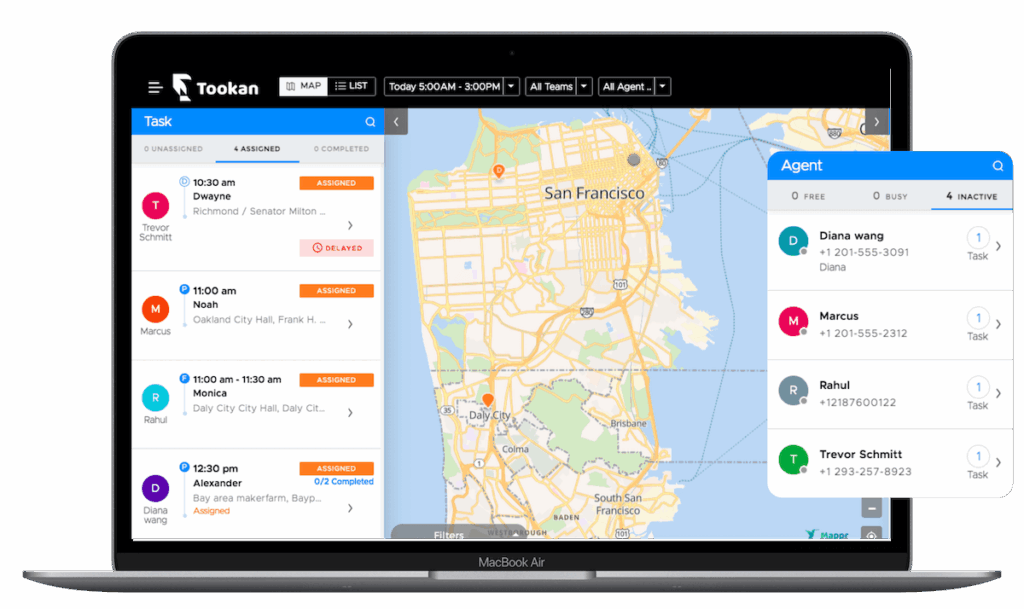
The productivity gains from these integrations accumulate across your organization. Platforms like Tookan offer extensive integration capabilities that allow growing businesses to create seamless workflows connecting every aspect of their operations.
Competitive Positioning
In competitive delivery markets, operational efficiency directly impacts your ability to win and retain business. Logistics management software provides capabilities that help you compete on both price and service quality.
When your operational costs are lower due to route optimization and labor efficiency, you can offer more competitive pricing while maintaining healthy margins. This pricing flexibility helps you win price-sensitive contracts without sacrificing profitability.
Simultaneously, the service quality improvements from real-time tracking, accurate ETAs, and professional communication help you compete for premium customers who prioritize reliability and experience. You can pursue both value-focused and premium segments effectively.
The scalability that software provides also positions you to pursue larger contracts that manual operations couldn’t support. When a major customer needs a delivery partner who can handle 500 daily deliveries with consistent quality, your software-enabled operations make you a viable candidate while competitors using manual processes can’t scale effectively.
This competitive positioning translates directly into revenue growth opportunities that wouldn’t exist without the operational foundation that logistics management software provides.
Calculating Your ROI
Understanding the return on investment for logistics management software requires looking beyond the sticker price to examine total cost of ownership and comprehensive benefits.
Start by calculating your current operational costs across relevant categories: fuel, labor (both driver and administrative), vehicle maintenance, failed delivery costs, and customer service time spent on delivery inquiries. Then estimate the percentage improvements logistics management software typically delivers in each category based on industry benchmarks.
For most growing delivery businesses, the calculation looks something like this:
Monthly operational costs (before software):
- Fuel: $7,000
- Dispatch labor: $8,000
- Failed delivery costs: $2,400
- Customer service delivery inquiries: $1,800
- Extra driver overtime: $2,200
- Total: $21,400
Monthly savings (conservative estimates):
- Fuel reduction (25%): $1,750
- Dispatch efficiency (30%): $2,400
- Failed delivery reduction (70%): $1,680
- Customer service reduction (50%): $900
- Overtime reduction (40%): $880
- Total monthly savings: $7,610
Against monthly software costs typically ranging from $200-500 for growing businesses, the return becomes immediately apparent. Even at the higher end, your monthly savings exceed costs by more than 15x, delivering a payback period measured in weeks rather than months or years.
This calculation doesn’t even include the growth enablement value – the additional revenue you can capture because software allows you to scale efficiently. When you can grow from 100 to 300 daily deliveries without tripling your administrative team, that operational leverage directly enhances profitability.
Implementation Considerations
Achieving these returns requires successful implementation. While modern logistics management software is designed for ease of use, several factors influence how quickly you realize benefits.
Choose software with strong onboarding support and intuitive interfaces that minimize the learning curve. The faster your team becomes proficient, the sooner you capture efficiency gains. Look for providers offering training resources, responsive support, and implementation assistance.
Start with core features rather than trying to implement every capability simultaneously. Get route optimization and basic tracking working smoothly before adding advanced features. This phased approach allows your team to adapt gradually while beginning to capture returns immediately.
Measure baseline metrics before implementation so you can track improvements accurately. Document your current fuel costs, delivery capacity, failed delivery rate, and dispatch labor hours. These baselines make your ROI calculation concrete rather than theoretical.
Expect a 2-4 week adjustment period as your team adapts to new workflows. Initial productivity might dip slightly as people learn the system, but this temporary adjustment pays off quickly as efficiency gains emerge.
Long-Term Value Creation
The financial returns of logistics management software extend well beyond immediate operational savings. Over time, the cumulative benefits create substantial enterprise value that positions your business for long-term success.
The operational infrastructure that software provides makes your business more attractive to potential acquirers or investors. Companies with mature, scalable systems command higher valuations than those dependent on manual processes and institutional knowledge held by key individuals.
The data assets you accumulate through software become increasingly valuable over time. Historical performance data allows increasingly sophisticated analysis and optimization. Customer delivery preferences inform strategic decisions. This intelligence becomes a competitive moat that’s difficult for competitors to replicate.
Your ability to scale efficiently opens market opportunities that might otherwise remain out of reach. When a major retail partnership or regional expansion opportunity emerges, your software enabled operations allow you to capitalize on it rather than watching competitors seize the moment.
Making the Investment Decision
For growing delivery businesses, logistics management software represents not just an operational improvement but a fundamental business investment that pays measurable returns. The combination of immediate cost savings, scaling efficiency, customer experience improvements, and competitive advantages creates a compelling financial case that becomes stronger as your business grows.
The businesses thriving in today’s competitive delivery landscape aren’t those avoiding technology costs- they are those leveraging technology to create operational advantages that translate directly to profitability. Every day spent operating without logistics management software represents lost efficiency, unnecessary costs, and competitive ground ceded to more operationally sophisticated competitors.
The question isn’t whether logistics management software pays for itself – the data clearly demonstrates that it does, often many times over. The real question is whether you can afford to continue operating without it as your business grows and competition intensifies.
For delivery businesses ready to scale efficiently while protecting and expanding margins, investing in proven logistics management solutions delivers returns that extend far beyond the software cost. The combination of immediate savings, long-term competitive advantages, and growth enablement makes it one of the highest-return investments available to growing delivery operations.
Your delivery business has growth potential. The right logistics management software ensures that growth translates into sustainable profitability rather than operational chaos. That’s not just software – that’s a strategic business decision that pays dividends for years to come.
Link to: https://jungleworks.com/tookan/
Subscribe to stay ahead with the latest updates and entrepreneurial insights!
Share this article:


Subscribe to our newsletter
Get access to the latest industry & product insights.
You may be interested in these articles
-
16th October 2026
Incroyables opportunités financières avec https://bonuskongsfr.fr pour optimiser vos gains potentielsIncroyables opportunités financières avec https://bonuskongsfr.fr pour.. [..]Read story
-
16th October 2026
Fantastische bonussen en een breed spelaanbod vind je bij https://spinjoys-casino-netherlands.nl voor elke spelerFantastische bonussen en een breed spelaanbod vind je bij.. [..]Read story
-
16th October 2026
Geweldige kansen en harry casino bieden een spannende spelervaring voor iedereenGeweldige kansen en harry casino bieden een spannende spelervaring voor.. [..]Read story
-
28th September 2026
SlotLounge Casino Review: App, Login, Bonuses, and MoreSlotLounge Casino offers an impressive gaming experience with a user-friendly.. [..]Read story