-


-
-
Softwares
Logistics

Tookan
Delivery management software for optimizing fleet operations

Evermile
Last-mile delivery orchestration platform with real-time tracking

Mappr
Route optimization and territory mapping for delivery networks
Commerce

Yelo
On-demand delivery platform for restaurants and retail businesses

Jugnoo
Hyperlocal delivery and ride-hailing solution for urban markets
Pickup and Delivery Apps
Hassle free ordering process with Tookan Customer apps.
Growth

Outplay
Sales engagement platform for high-performing teams

Appvirality
Referral Marketing Software Designed for Accelerated Growth

Rivia.ai
One platform to showcase, onboard, listen, and grow

Super Hippo
Customer engagement platform with omnichannel messaging

Growthscore
Collect Actionable Feedback and Boost Customer Satisfaction with NPS

NOTP
customer engagement solution that lets users log in or sign up via WhatsApp
-
-
Brands
- Consulting
-
Ordering
Food Grocery Home Services -
Delivery & Dispatch
Pick Up & Delivery Courier Delivery 3PL Delivery Dispatch -
Consultation
Telemedicine Fitness Legal Consultation -
Mobility
Taxi Software App Like Uber Car Rental -
Customer Engagement
Conversational support WhatsApp Marketing Customer Acquisition -
Sales Engagement
Inbound Sales Pipeline Management Sales Performance Analytics
Explore All Industries
-
- Brandcamp
-
Learn







Blog Yelo
Yelo
How AI Is Transforming Hyperlocal Marketplaces in 2026: From Personalisation to Autonomous Delivery
Urban commerce in 2026 is no longer defined by distance—it’s defined by intelligence. Hyperlocal marketplaces, once focused primarily on proximity and speed, have evolved into deeply intelligent platforms powered by artificial intelligence. Today, AI in hyperlocal marketplaces is not an enhancement; it is the foundation that determines efficiency, scalability, and profitability.
Earlier, consumers had to search, compare, and wait. Now, AI predicts needs, personalizes experiences in real time, and orchestrates deliveries autonomously. As a result, hyperlocal platforms are transitioning from reactive order-taking systems into proactive, self-optimizing ecosystems.
In this blog, we’ll explore how AI in hyperlocal marketplaces is transforming everything—from personalization and demand forecasting to logistics and autonomous delivery—backed by real data, industry statistics, and future-ready insights. Finally, we’ll examine how platforms like Yelo help businesses adopt AI without complexity.
1. Understanding Hyperlocal Marketplaces in 2026
Hyperlocal marketplaces connect consumers with nearby sellers or service providers, typically within a limited delivery radius. These platforms include grocery delivery, food ordering, pharmacy delivery, home services, quick commerce, and local retail aggregation.
However, what truly differentiates modern platforms is AI in hyperlocal marketplaces, which enables them to:
- Understand local demand patterns
- React to real-time conditions
- Optimize supply, pricing, and delivery dynamically
Unlike traditional ecommerce, hyperlocal success depends on speed + relevance + operational precision—and AI is the only technology capable of balancing all three at scale.
2. Why AI Has Become Central to Hyperlocal Growth
The rapid adoption of AI is driven by both customer expectations and operational pressures.
According to recent industry data:
- The AI ecommerce market crossed $9 billion in 2025, growing at over 24% CAGR
- Nearly 78% of digital commerce businesses now use AI in at least one operational function
- AI-driven platforms consistently outperform competitors on margins and customer retention
Consequently, AI in hyperlocal marketplaces is no longer optional—it is essential for survival in crowded, low-margin markets.
3. AI-Driven Personalisation: From Static to Predictive
Personalisation is where AI creates the most visible impact.
3.1 Contextual and Behavioural Personalisation
Earlier recommendation engines relied on basic purchase history. In contrast, AI in hyperlocal marketplaces now combines:
- Location intelligence
- Time-based behaviour
- Weather conditions
- Local events and festivals
- Real-time inventory availability
As a result, platforms can personalize what is shown, when it’s shown, and how it’s priced.
Studies indicate that AI-led personalization increases:
- Conversion rates by 6–8%
- Average order value by 3–5%
- Repeat purchase frequency significantly in hyperlocal contexts
3.2 Conversational AI and Voice Commerce
Equally important, conversational AI has transformed how users interact with platforms.
Instead of navigating menus, customers can simply say:
“Order vegetables for tonight”
“Book a home salon service at 7 PM”
Thanks to NLP and intent recognition, AI in hyperlocal marketplaces reduces friction and accelerates order completion—especially on mobile and voice-first devices.
3.3 Predictive Customer Journeys
Moreover, predictive AI now anticipates demand before customers act. This includes:
- Automated restock reminders
- Subscription-like recurring orders
- Smart notifications based on consumption patterns
Thus, hyperlocal platforms move from transactional models to habit-driven engagement loops.
4. AI in Demand Forecasting and Inventory Management
Inventory inefficiency is one of the biggest profit killers in hyperlocal commerce. Overstocking leads to waste, while understocking results in lost orders.
This is where AI in hyperlocal marketplaces plays a transformative role.
4.1 Predictive Demand Planning
AI models analyze:
- Historical sales data
- Micro-location demand trends
- Seasonal and cultural patterns
- Promotion impact
As a result:
- Inventory holding costs reduce by 20–30%
- Stock-outs decline significantly
- Merchants maintain healthier margins
Furthermore, AI allows marketplaces to support ultra-fast delivery promises without inflating operational costs.
4.2 Real-Time Inventory Visibility
Using computer vision and automated tracking, AI enables real-time inventory synchronization across sellers, dark stores, and fulfillment hubs. This ensures higher order accuracy and fewer cancellations.
5. AI-Powered Logistics and Route Optimization
Delivery is the most expensive component of hyperlocal operations. In many cases, last-mile logistics account for 40–50% of total operational costs.
Therefore, AI in hyperlocal marketplaces focuses heavily on logistics intelligence.
5.1 Dynamic Route Optimization
AI continuously evaluates:
- Traffic congestion
- Weather disruptions
- Rider availability
- Order density
Then, it dynamically recalculates routes in real time. Consequently:
- Delivery times drop
- Fuel costs reduce
- Rider productivity increases
5.2 Intelligent Fleet Allocation
Additionally, AI decides which delivery agent should handle which order—based on distance, capacity, and historical performance. This minimizes delays and improves service reliability.
6. Autonomous Delivery: The Next Frontier
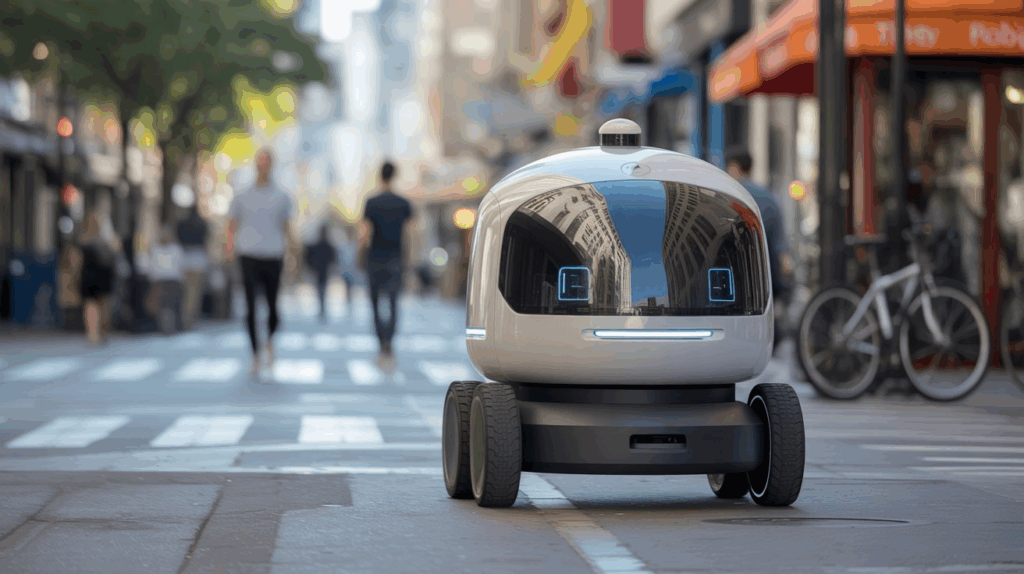
Perhaps the most disruptive outcome of AI in hyperlocal marketplaces is autonomous delivery.
6.1 Robots, Drones, and Autonomous Vehicles
By 2026, autonomous delivery has moved beyond pilots into real-world deployment.
Key stats:
- Autonomous last-mile delivery market projected to reach $144+ billion by 2033
- Robots and autonomous vehicles form the largest growth segment
- Millions of real-world deliveries already completed globally
These systems rely on AI for:
- Navigation and obstacle detection
- Real-time decision-making
- Safety and compliance
6.2 Hybrid Human + Autonomous Models
Importantly, the future isn’t fully robotic. Instead, AI in hyperlocal marketplaces enables hybrid models where:
- Humans handle complex or sensitive deliveries
- Robots manage short, repetitive routes
- Drones serve time-critical orders
This balance improves scalability without eliminating human roles.
7. AI in Warehousing and Micro-Fulfilment
Hyperlocal fulfillment centers are becoming smarter, smaller, and faster.
AI-powered warehouses use:
- Robotics for picking and sorting
- Computer vision for quality checks
- Predictive replenishment systems
For example, large platforms deploying robotics have seen:
- Faster order processing
- Reduced human error
- Lower fulfillment costs
Once again, AI in hyperlocal marketplaces ensures speed without sacrificing accuracy.
8. AI-Driven Customer Support and Engagement
Customer experience doesn’t end at checkout.
AI now powers:
- 24/7 chatbots and virtual assistants
- Automated order updates
- Sentiment analysis for proactive issue resolution
Interestingly, nearly 50% of customers are comfortable interacting with AI agents, especially when issues are resolved faster.
Thus, AI in hyperlocal marketplaces reduces support costs while improving satisfaction.

9. Ethical, Regulatory, and Trust Considerations
With great intelligence comes great responsibility.
Key considerations include:
- Data privacy and consent
- Algorithm transparency
- Autonomous delivery safety regulations
- Fair workforce transitions
Platforms that embed ethical AI frameworks will gain long-term customer trust and regulatory resilience.
10. Challenges Still Facing AI Adoption
Despite the progress, challenges remain:
- High-quality data dependency
- Infrastructure investment for autonomy
- Regulatory fragmentation across regions
- Consumer trust in full automation
However, platforms that partner with mature AI-enabled SaaS providers can overcome these barriers faster.
11. How SMBs Can Leverage AI Without Complexity
Contrary to popular belief, AI in hyperlocal marketplaces is not limited to big tech players.
Today, SMBs can adopt AI through:
- Plug-and-play marketplace platforms
- AI-ready analytics dashboards
- Automated personalization engines
- Smart logistics integrations
The key is choosing technology partners that abstract complexity while delivering intelligence.
12. How Yelo Enables AI-Powered Hyperlocal Marketplaces
Yelo empowers businesses to leverage AI in hyperlocal marketplaces without building everything from scratch.
12.1 Intelligent Personalisation
Yelo enables:
- Behaviour-based recommendations
- Location-aware discovery
- Dynamic storefront experiences
This helps marketplaces drive higher engagement and conversions.
12.2 Smarter Operations
With Yelo, businesses gain:
- Data-driven insights into demand and performance
- Automated alerts and analytics
- Scalable marketplace management
As a result, decision-making becomes faster and more accurate.
12.3 Logistics-Ready Integrations
Yelo seamlessly integrates with:
- AI-powered delivery platforms
- Route optimization engines
- Autonomous delivery partners
This allows businesses to future-proof their operations.
12.4 Scalable Growth Architecture
Finally, Yelo’s modular platform ensures that as AI evolves, businesses evolve with it—without expensive redevelopment or downtime.
Conclusion
In 2026, AI in hyperlocal marketplaces defines competitive advantage. From predictive personalization and intelligent logistics to autonomous delivery and real-time analytics, AI is reshaping how local commerce operates.
The future belongs to platforms that are not just fast—but intelligent, adaptive, and customer-centric.
By leveraging solutions like Yelo, businesses of all sizes can tap into AI-driven hyperlocal commerce and compete with industry leaders—without complexity, risk, or massive upfront investment.
Subscribe to stay ahead with the latest updates and entrepreneurial insights!
Share this article:


Subscribe to our newsletter
Get access to the latest industry & product insights.
You may be interested in these articles
-
Yelo4th February 2026
How to Create Online Ordering for a Restaurant (That Gets Results)In the modern food service landscape, online ordering for restaurants has.. [..]Read story
-
Yelo21st January 2026
Beyond the Storefront: How Direct-to-Consumer (D2C) Brands Are Reclaiming Their Margins in 20261. Introduction: The Great Decoupling of D2C Brands By 2026, the digital.. [..]Read story
-
Yelo14th January 2026
How Hyperlocal Delivery Is Changing Urban E-commerce: Trends and Predictions for 2026The retail landscape has undergone a dramatic transformation. As we move.. [..]Read story
-
Yelo7th January 2026
Mastering Hyperlocal Commerce: Proven Growth Strategies to Boost Orders for Local Businesses in 2026In the digital landscape of 2026, the way we perceive local commerce has.. [..]Read story